Yesterday it rained heavily in Barcelona. Today there are still puddles on pavements, in courtyards and along kerbs. Some are elongated, some have irregular edges, and others are trapped between paving tiles or next to the kerb. They still seem like small temporary systems to me: they appear, reflect, accumulate and disappear. A puddle seems to be the result of rain, but it is also the beginning of another process: from the moment it forms, it already starts to disappear.
Puddles have always interested me. As a child I spent time looking at them after the rain, observing how they changed, what shapes they took and how they reflected their surroundings. At one point I even tried to freeze one, collecting water from a puddle and putting it in the freezer to see whether I could preserve, even for a while, that accidental shape. Of course, once frozen it was no longer the same puddle, but that attempt forms part of my continuing interest in this kind of phenomenon.
This article studies how a drop of water evaporates when its footprint is not circular. Using a mathematical model, the authors analyse how the shape of the boundary conditions the evaporative flux. Although the model is posed for very thin droplets, it also applies to larger “pancake” droplets or puddles, where gravity dominates.
I am interested in thinking that the accidental form water finds on the ground — a slope, a crack, an irregularity in the pavement — already contains part of the story of how that water will disappear. Not every point along the edge evaporates equally: the geometry of the perimeter determines how water is lost to the atmosphere and what internal movements are generated in the droplet.
About the paper and the figure
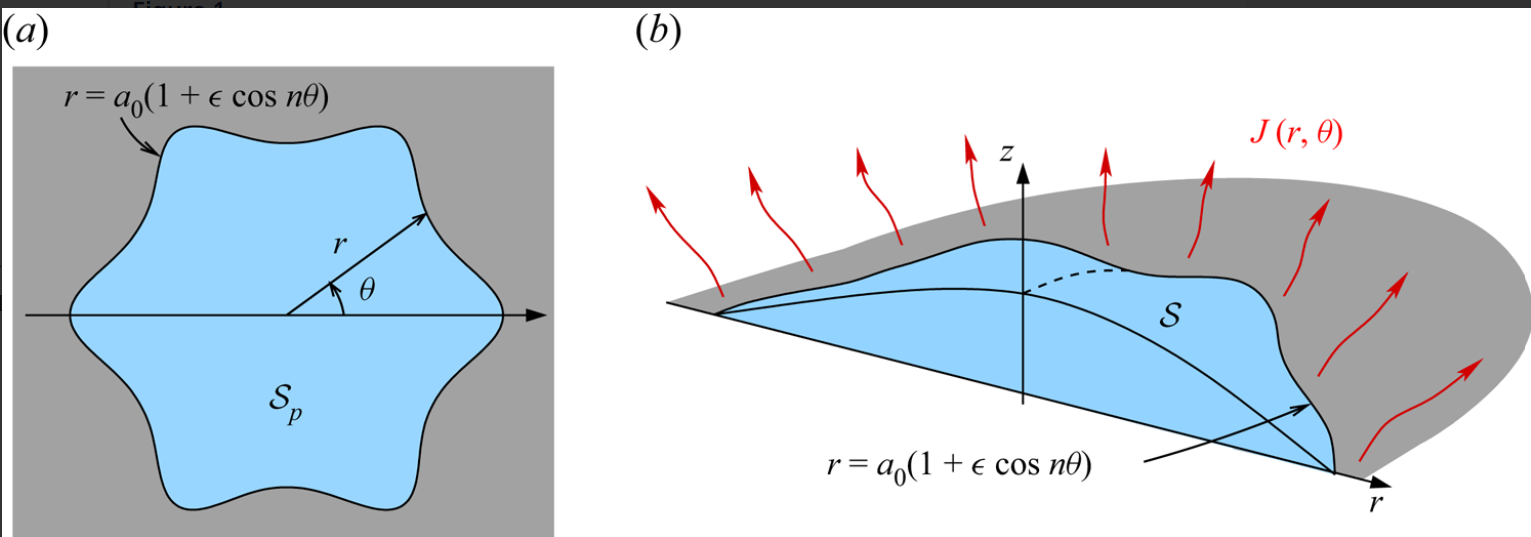
The figure shows a schematic of the geometry studied by the authors. In (a) we see the top view of a droplet with a non-circular boundary, described by the function r = a₀(1 + ε cos nθ), which introduces small irregularities along the edge. In (b) we see the side view of the same very thin droplet resting on a substrate, with red arrows representing the vapour flux, J(r, θ), escaping into the atmosphere.
The article analyses how boundary shape affects the evaporation rate. Through a mathematical model, the authors solve the vapour concentration field around the droplet and calculate the evaporative flux at every point on the surface. Although the diagram corresponds to a thin droplet, the study also extends to larger puddle-like or “pancake” droplets, where gravity becomes more relevant. In all cases, the geometry of the perimeter plays a key role in how water is lost.
Wray, A. W. & Moore, M. R. (2023). Evaporation of non-circular droplets. Journal of Fluid Mechanics, 961, A11.
← Back to blog